At a time of rising populism in the West, Pedro Sánchez’s Spain appears increasingly open in its hostility towards the policies pursued by Donald Trump on the other side of the Atlantic. While the government is grappling with corruption allegations ahead of the 2027 elections, Madrid stands out as an exception in Europe by refusing to align with the American position on defence. This stance is part of an increasingly polarised transatlantic landscape, in which the United States’ disengagement from multilateral frameworks clashes with the assertion of a progressive Spanish line. The Hague Summit of June 2025 crystallised this rift: as we shall see, American withdrawal and Spanish resistance are converging towards an overall weakening of the Atlantic Alliance.
American disengagement
Since 2025 and the start of Donald Trump’s second term, the United States seems to be displaying its disdain for international institutions. Its withdrawal from the WHO is proof of this challenge, which also seems to put forward a new conception of the transatlantic organisation. The Secretary of War, Pete Hegseth, has thus called for a far-reaching reform of the 32-member Alliance to turn it into a “NATO 3.0” – in other words, a military organisation that would become increasingly independent of the United States.
As a result, the Trump administration continues to assert its political line: “America First”, presented as a policy of exclusion and seen by Spain as a form of unilateral disengagement. Indeed, the administration has been facing a wave of protest against its domestic policy for several months. The occupant of the White House faces a public opinion that accuses him of involvement in the Epstein files and of supporting a contested Israeli policy, on top of his controversial immigration policy following the excesses of ICE (United States Immigration and Customs Enforcement): all factors that weaken his legitimacy, without however slowing his assertiveness on the international stage.
Donald Trump nevertheless seems to be multiplying provocations, particularly in his foreign policy, which is marked by strong interventionism (Iran, Venezuela) and by increasingly frequent threats of annexation (Canada, Greenland, etc.). From this point of view, Madrid is not spared the intimidation and bluntness that characterise the American president, who recently described the country as “ruined” and threatened to stop all trade with Spain. Spain’s refusal to allow the Americans to use the Rota and Morón bases has thus angered the White House: “These allies are putting America’s sons and daughters in danger, […] by denying them […] the use of bases and overflight of their territory, rights that should never have been called into question” – a dispute that seems to further polarise the two members of the Alliance.
The progressive Spanish exception
For its part, Pedro Sánchez’s Spain has implemented a very different policy, based on social advances in favour of immigration (in contrast to its American counterpart). Up until last June, the Spanish government regularised nearly 500,000 undocumented foreigners in order to address labour shortages and the ageing of its population. This decision drew strong reactions from the right and the far right in Europe, which accuse the socialist prime minister of allowing a “migratory submersion”, in the words of Jordan Bardella in April 2026.
Madrid has also stood out on the world stage by recognising the State of Palestine on 28 May 2024 (before Trump’s second term) and by adopting a non-interventionist diplomatic posture summed up by its famous “No a la guerra” (“No to war”) in response to American threats. Here again, the Iberian country stands apart from the United States, which supports the Israeli position in the context of the war in Gaza. Internationally, Spain is asserting its position as the left retreats across Europe.
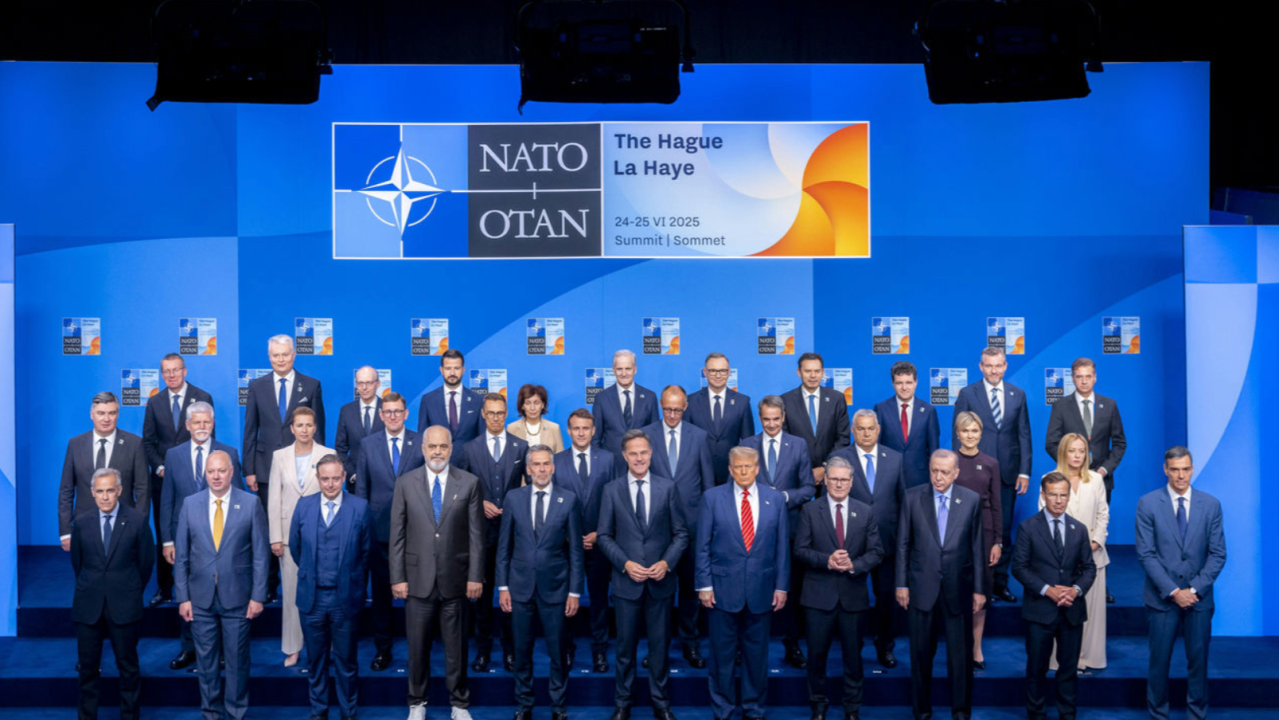
It is in this context that Spain displays its rejection of populism and forms a front against Trumpism and the far right that is gaining ground on the continent. The reactions of politicians advocating an anti-immigration line (in particular after the incident in Ceuta on 30 July 2026) show an ideological divergence that further fractures the Atlantic Alliance. Madrid’s isolation was even visible at the NATO Summit in The Hague on 24 June 2025, where Pedro Sánchez seemed to keep his distance.
A weakened Alliance
The political division fracturing the transatlantic Alliance appears to be a structural weakness in relations between the United States and Spain, and more broadly among NATO members. The Alliance is becoming aware of its dependence on the Pentagon for defence – a Pentagon that spent nearly 980 billion dollars in this area in 2025. This policy runs counter to the pacifist stance of the Spanish prime minister, who rejects the policy of NATO Secretary General Mark Rutte of devoting 5% of GDP to security by 2035, calling it “incompatible with our welfare state”. The United States thus appears as the indispensable pillar of the Alliance, a role Donald Trump never fails to point out.
Beyond their political differences, the Spanish–American relationship highlights European divisions over their stance on the international stage. NATO members seem more divided than ever in the face of the rise of radical parties that prioritise domestic policy, as in the United States or Italy, at the expense of the cooperation and integration efforts supported by Spain. A distinction is therefore emerging among the members of the transatlantic organisation: on one side, moderate countries that favour a foreign policy based on diplomacy; on the other, countries that align with the position of the American president by adopting an aggressive and nationalist policy.
This rift within NATO thus sums up the difficulty of reaching unanimous consensus, while facing the risk posed by a Spanish exemption. By obtaining a derogation, Spain sets a dangerous precedent: if Madrid escapes the 5% target, other Allies could claim the same right, thereby weakening the whole collective edifice on which the credibility of NATO’s commitment rests.
In short, Washington’s gradual withdrawal from multilateral frameworks, combined with Spain’s resolutely progressive stance, outlines a weakened transatlantic Alliance. Madrid’s refusal to align with the 5% of GDP target goes beyond a mere budgetary dispute: it crystallises an opposition between two visions of collective security. This ideological rift raises questions about the very future of NATO in the face of the growing disinterest of the world’s leading power.
Clémence Lalain
Clémence Lalain, a second-year student on a joint bachelor’s degree in History and Political Science at the Institut Catholique de Paris, is particularly interested in contemporary geopolitical and diplomatic issues, as well as questions of human rights and inequality.
Articles published in the AFCEA Journal reflect only the views of their authors. Article originally published in French on LinkedIn on 18 October 2026. Illustration: NATO Summit in The Hague, 24–25 June 2025.
This article was translated from French by Claude (AI). In case of any discrepancy, the French version prevails.
Leave a Reply