Category: Members’ activities

  • International relations: golden goose or fool’s gold?

    International relations: golden goose or fool’s gold?

    Crises follow one another, experts proliferate, academic programmes multiply. And companies are beginning to realise that they can no longer ignore a world they thought they could keep at a distance. International relations and security and defence have become a “market”. But a market for whom? And for whose benefit?

    In more than twenty-five years of supporting business leaders, I have rarely met economic decision-makers who were truly aware of international relations issues in their security and defence dimensions.

    For most of them, the world was an open playing field – to be discovered, conquered and used to cut costs, whether on supplies or services. Globalisation was a happy one, people said. And in this context, the question of the long-term preservation of skills and production, particularly in industry, was not raised often enough.

    I fondly remember one executive who courageously chose to leave a prestigious position rather than accept, as his group’s leadership wished, a contract with leonine clauses: in exchange for short-term orders, he would have guaranteed the (Asian) buyer control over his company’s key skills in the medium and long term.

    But he was the exception. Around him, few of his peers really asked these questions. Security issues? Barely mentioned. Those of “global defence”, in their economic, technological and political dimensions? Almost absent from conversations.

    During those same years, I had also come to know and meet, one way or another, almost all the think tanks active on these subjects and their experts. The “market” was in fact very small. It was fairly easy to take part in exchanges between motivated representatives of “civil society” and the rare specialists in diplomatic or military matters.

    All this has changed in recent years. And in these changes, I see both positive dynamics and worrying developments.

    More and more programmes: good news, with perverse effects

    During my student years and until the mid-1990s, programmes dedicated to international relations and security and defence could be counted on the fingers of one hand. Assas-Paris 2, Lyon 3, ILERI in the private sector – with small cohorts. Sciences Po Paris too, of course. And Sciences Po Grenoble, although these subjects were not, a priori, a specialisation there. They were rather options grafted onto law, history or political science curricula.

    For those who wanted to learn without making it a career, other paths existed: for example, the open activities of think tanks and associations, or joining the military reserve. This is how, as an officer and then a senior officer over the years, I benefited from high-level training on these subjects, including alongside comrades from the active forces. And then there were the IHEDN sessions – national ones for a “happy few” and regional ones to raise awareness of these issues more widely among business leaders.

    In the early 2000s, the “market” for security and defence training grew. First the 9/11 effect: the brutal reminder that our world is never really at peace. Then the LMD reform (the bachelor–master–doctorate system), which seems to have encouraged the creation of specialised programmes where, previously, only a dissertation or thesis topic could signal a specialisation. But cohorts of graduates remained limited.

    Today, there is an abundance. There are between forty and sixty specialised programmes in international relations and security and defence, at all levels. Every year they put several thousand graduates on the job market, several hundred of them with specialisations that are hard to transfer to the business world. This is no doubt, as with the surge in volunteers for the armed forces, active or reserve, the effect of the 2015 attacks, which made people realise that peace and freedom are fragile goods.

    It is also a necessity and an opportunity for a field neglected for too long. But the real effects – notably the building of a pool of solid experts – will only be fully felt in a few years’ time. It takes ten to twenty years to acquire real legitimacy in these highly specialised fields, and it is good to see institutions now encouraging investment in academic security and defence research. It is never too late…

    But today’s specialists are those who began their studies in the 2000s, who are now in their forties, and whose scarcity is felt anew with every crisis. We saw this, for example, during the Russian invasion of Ukraine in 2022, when genuine experts – women and men alike – were particularly rare, and therefore in extremely high demand.

    Yet this profusion of programmes is already producing negative effects. Internship offers in the relevant institutions are multiplying, without necessarily leading to lasting jobs. Too many young graduates come up against a shortage of openings. And those who resign themselves to approaching sectors further from their original career plans struggle to make the most of skills too specialised to be transferred.

    They thought they had found the golden goose. Many are discovering fool’s gold.

    The rush for expertise: between legitimate experts and opportunists

    In this context of growing demand, not everyone loses out – at least not in the short term.

    Rolling news channels need to fill their studios. With recognisable faces and confident, even divisive – “polarising”, as they say – discourse. And when the rare genuine experts are overwhelmed with requests, or honestly judge that their expertise is not the most relevant for the topic of the moment, other profiles rush into the gap. With aplomb, a certain rhetorical ease and a lack of scruples that can fascinate as much as it should normally worry. For some, media fame has become capital in its own right, independent of any proven competence.

    The academic programmes that continue to develop also attract speakers of variable quality. Among them, fortunately, are academics whose training and intellectual rigour allow them to broaden their initial field without sacrificing the quality of their contributions. These profiles are precious, as they ensure serious teaching continuity amid this profusion of programmes. But the same programmes also include speakers more attracted by fame or financial rewards than by teaching, who impose themselves with more conviction than proven competence. Speakers whom programme directors accept, often for lack of anything better or for lack of discernment, but because students have to be attracted somehow.

    Curiously, few recognised experts come from the diplomatic world. Is this due, with a few well-known exceptions, to a natural reserve acquired over a career that teaches discretion? Or to a status that encourages such reserve? It is a pity in any case, because the diplomatic approach has its own specificity, its own reading of crises, different from that of the military or academics, and complementary.

    On the other hand, many former military officers have taken on this role of public expert. Their presence is partly explained by a very specific structural reality: career management for senior officers and generals could not guarantee all of them a move into defence companies, especially in recent years, which have been difficult for the sector. With the reduction in the number of units, and therefore of their commanders, many high-ranking officers were pushed out of the institution while still fully eager – and for some, obliged for personal and family reasons – to quickly start a “second career”.

    Among them, genuine experts – those who have really worked on strategic, geopolitical and operational issues – are in fact rare. As is their voice. Others, less scrupulous about the gap between their actual experience and the claims they make, skilfully trade on the prestige of the institution, of their predecessors and of the most deserving of their contemporaries, wrapping themselves in it. Presented, at least implicitly, as seasoned warriors and high-flying strategists, they were often above all peacetime administrators. Useful cogs, certainly, but executors within a large bureaucracy that has little to teach a world seeking agility, innovation and rapid decision-making in an uncertain environment.

    For some of them, the multiplication of programmes is an additional opportunity, particularly outside the university world, which is strictly bound by precise qualification criteria. So is the creation of new “think tanks” with often opaque statutes and funding, which multiply public statements without anyone being able to really assess the seriousness of their expertise. These structures seek in particular to enhance their facade with “2S” generals – generals in the “second section” – a term most recruiters and journalists do not even fully understand. (As a reminder: in theory, general officers placed in the second section could be recalled to command in time of war. Which may legitimately worry, given some of the profiles appearing on television today…)

    Companies: a new clientele or a call to mobilise?

    In theory, companies are a natural outlet for all these people trained in the challenges of a changing world. Not only in the arms or security sector. Not only because conflicts are increasingly hybrid and technologies increasingly dual-use. But because all these dimensions must now be built into the strategic management of any organisation with an international dimension – in its supplies, its markets, its partners.

    But do they need the specialists available on the market and those produced by today’s programmes?

    When programmes remained “generalist with individual specialisation”, highly specialised profiles found work – in academic institutions and think tanks, which are more numerous elsewhere than in France. And more open profiles could put their knowledge of international issues to use as one asset among others, serving broader skills: risk management, international commercial negotiation, strategic intelligence. A “little something extra”.

    The growing specialisation that now accompanies the multiplication of programmes has become a real obstacle to employment. Crises and geographical tensions are multiplying, certainly. But no company, outside dedicated institutions and think tanks, can permanently employ a specialist for each country or area of tension. Highly specialised new graduates arrive on a narrow, quickly saturated market, with skills whose transfer into organisations remains hard to put to use.

    They thought it was the golden goose, when it is more likely fool’s gold.

    The “warriors”: fascinating, but rarely transferable

    There is another type of profile finding a growing echo in companies: former special forces operators – real warriors – and, more recently, a few former intelligence officers who openly embrace and promote that past, in contrast with their predecessors’ tradition of discretion. The “Le Bureau des Légendes” or “Cœurs noirs” effect? Or simply the cult of the ego spreading to every part of society?

    These profiles fascinate. Their stories make people dream. The “team-building” sessions they run are often unforgettable.

    But their capacity to inspire – and above all to genuinely transfer skills – is extremely limited. Olivier Schmitt’s work demonstrates this well: wartime military organisations and civilian organisations are radically different in nature, culture and decision-making mechanisms. Peacetime structures (including defence and security organisations) can be compared. Wartime structures cannot be transposed.

    For the crises that companies and civilian organisations go through, even the most violent, have nothing in common with war except the name some give them a little too quickly. Unless a company literally finds itself under fire – in which case it is no longer about producing, but surviving.

    What our companies really need

    In these troubled times, international relations and security and defence issues thus appear as a new El Dorado. The major consulting firms, which have appeared quite recently in spaces devoted to strategic debate, now offer dedicated expertise – or rather their usual teams, flanked by one or two “big names” more responsible for opening doors than for truly enriching the services. And the self-appointed experts mentioned above thrive on a general lack of knowledge of the fundamentals, amid a now widely felt sense of urgency.

    For genuine experts, the period is no doubt favourable – and that is a good thing, as for too long they worked without real recognition of their added value. But these benefits are structurally limited: maintaining a high level of expertise requires continuous time for monitoring, reading and exchanges – time that cannot be monetised without being sacrificed.

    Yet companies urgently need to make progress on these subjects. For several reasons that are no longer a matter of debate, but of the concrete reality of running an organisation.

    You can no longer invest anywhere and with anyone without asking the right questions – something some should have had in mind well before today’s crises forced them to. Every company has a moral and legal responsibility for the safety of its employees, its partners and their families, whether in areas of geopolitical tension or in the face of new forms of hybrid threats, be they physical, technological or cognitive. Our collective future and the preservation of our freedoms also depend on the strength and durability of our companies, which are political actors (in the sense of actors in the life of the city) as much as economic ones. And international relations should now be part of the general culture every decision-maker needs in an interconnected, competitive world where the rules of the game are changing at unprecedented speed.

    These needs are real. And to meet them effectively, companies need two very different – and complementary – types of profile.

    Recognised specialists, first of all – to provide in-depth, rigorous expertise based on years of serious work, and to genuinely inform strategic decisions. Experts who must be identified beyond the high-profile media figures, whose availability is often low and whose up-to-date competence, as we have said, is sometimes debatable.

    But also, and perhaps above all, translators. Because when two worlds are too far apart, the lessons of one cannot be fully transposed to the other. The most brilliant specialist, if they do not speak the language of business, will not be understood – or worse, will be misunderstood. The “culture shock” is too great to bring about real ownership and change. It can fascinate, sometimes. It often paralyses.

    These translators are by nature “marginal secants” – a sociological concept describing individuals who belong to several groups at once, able to move between and connect worlds that, without them, would not talk to each other. Women and men with a foot in both worlds. Who speak both languages. Who have that “little something extra” that enables and enriches exchanges between experts sometimes locked in their own world and decision-makers and managers reluctant to open up to these additional constraints, or overwhelmed when trying to integrate them.

    These “translators” are not “new specialists”, like the “chief geopolitical officers” some are calling for. Creating such a function with such a title, as some did with “chief digital officers” at the start of the wave of “digital transformations”, risks isolating a competence that should be shared as widely as possible. Unless the aim is to make an impression (but is that virtuous?), briefly create momentum and then disappear as quickly as possible, as was the case for CDOs.

    They may be former military officers. But of the kind who have also knocked around the genuinely civilian world, and not only in the defence industrial and technological base, which keeps its players in a sometimes misleading closed circle as regards their understanding of business dynamics. These profiles are rare. But they exist (I know at least one), and their value is real.

    They are also former students of programmes that were “both generalist and specialised”, who acquired solid foundations, kept them up through curiosity and practice over the years, while developing other skills – management, negotiation, complex project management – directly useful in organisations.

    Tomorrow, they will also be those who have resisted the temptation of overly narrow specialisation, which stifles both curiosity and employability. Those who have understood that the value of a profile in a company or a large organisation is measured not by the depth of a niche, but by the ability to connect worlds.

    And finally, they are those who, through their unusual paths and personal commitment, have cultivated knowledge and practice of both worlds and their practitioners. Those who can make the right connections, beyond labels and titles, building bridges of understanding between cultures that, without them, would look at each other from afar without ever really talking. “Go-betweens” who seek not to impress but to mobilise and move things forward.

    These “translators”, these “marginal secants”, do not make magazine covers. They do not fill television studios. But they too are the ones who will enable our companies and their leaders to move forward in a world that neither warriors nor television experts can, on their own, help them understand and take in hand.

    Alexis Kummetat


    This article reflects only the views of its author. Article originally published in French on LinkedIn on 12 March 2026.

    This article was translated from French by Claude (AI). In case of any discrepancy, the French version prevails.
  • Sustaining the transatlantic relationship and supporting NATO’s transformation through associative action

    Sustaining the transatlantic relationship and supporting NATO’s transformation through associative action

    In his speech of 20 January 2026, Canadian Prime Minister Mark Carney spoke of a “rupture”, in order to adapt to the world “as it is”. Is it really a rupture, or a new evolution?

    The Atlantic Alliance has been through many crises, and the “burden shifting” at the heart of the current transformation is not a new question: it was raised as soon as the Alliance was created. It is true, however, that this “shift”, as it is presented, would grant Europeans more or less autonomy – which may look, to those concerned, like contradictory injunctions: “do it on your own, but not without us”.

    Back in 1975, Raymond Aron was already calling on “my friend the American Secretary of State (Henry Kissinger, author’s note) (who) need only read one thing, namely the books he wrote when he was a professor at Harvard” to ask him, at the time, to adopt a more benevolent attitude towards the Common Market.

    Professor Pierre Melandri, for his part, described the late 1990s as the shift, from the American point of view, from the “new Atlanticism” sought by US Secretary of State James Baker to the “lite” alliance of George W. Bush: “as a result, too, more than ever, the Americans seemed determined at all costs to prevent the emergence of a united Europe capable of threatening a unipolarity elevated into a panacea”.

    The Alliance is certainly going through major changes. But if there is a “rupture”, it is perhaps above all in the style of some, in a world where blows were exchanged, but in a civilised way.

    Nobody, except Putin and his henchmen, really wants the end of the North Atlantic Treaty Organization (NATO). To adapt to the world “as it is”, and not “as we would like it to be”, it must therefore succeed in its transformation.

    So, since NATO must transform itself, do we prefer an imposed transformation (moving, for example, to a “Warsaw Pact” model) or a chosen one (rediscovering the spirit and workings of Euro-Atlantic solidarity)?

    The proposal developed here is that it is possible to transform NATO while remaining true to its purpose and to the spirit of its founders, by evolving it to meet the diverse expectations of its members. And to do so by building on some fundamentals of the Atlantic Pact, as it was called in the 1950s, remembering its “raison d’être” and adapting its workings to what it should never have stopped being: a collective dynamic.

    Two types of arguments will be presented here in support of this proposal.

    Some come from my professional experience of leading transformations in organisations.

    And unlike Olivier Schmitt, I believe it is possible to apply some practices of “civilian” organisations to the transformation of the Alliance.

    First, because NATO is a politico-military alliance, not just a military one. And also because the military world, despite the very particular nature of its combat missions, has many similarities with civilian organisations.

    By way of illustration, in an article in the January issue of DSI magazine, Laure Bardiès recalls, in Marc Bloch’s book on the reasons for the 1940 defeat, “the most pervasive aspects of military bureaucracy”. “Bureaucracy” and its effects are common to all large organisations, military or civilian.

    More lightly, Thierry de Montbrial noted, when presenting Hervé Pierre’s book on André Beaufre at IFRI, that “there is plenty of scheming in the armed forces too”… as in many human organisations. And readers involved in the life of such organisations will no doubt have other examples, as I have experienced myself.

    The other arguments come from the past and present of the Euro-Atlantic associations brought together in the Atlantic Treaty Association (ATA), whose French branch is the Association Française pour la Communauté Euro-Atlantique (AFCEA). An association whose historical foundations draw in particular on the action of Georges Bidault on the political side – who, with Britain’s Bevin, was one of the main architects of the Alliance – of Raymond Aron on the philosophical side, and of General André Beaufre on the military side.

    The people Olivier Zajec referred to in the podcast “La Loupe” in December 2025, for whom “the Atlantic Alliance cannot be reduced to NATO; it is a civilisational alliance, a community of destiny. We share values, a culture and a history with the United States”.

    Moving beyond discord, or rather overcoming it, by building on Article 2

    Article 2 of the Washington Treaty promotes the economic dimension of the Alliance and, more broadly, dialogue between its signatories. It is known as “the Canadian article” because it was introduced at the request of Lester Pearson, then Secretary of State for External Affairs, who believed that political and economic cooperation would remove the causes of war – a conviction also found on the other side of the Atlantic among the advocates of European integration.

    Article 4 also refers to the need for consultation between members, but in the event of a direct threat to their territorial integrity, political independence or security.

    Set up in May 1956 to give substance to these two articles, the “Committee of Three” produced in December the “Report of the Three Wise Men”, which recognised the need to broaden cooperation and, very concretely, to resort to “prior collective discussion” among the members of the Alliance, beyond military matters alone – just a few days after the end of the Suez crisis.

    Yet what was highlighted in the “Report of the Three”, and the only dimension really implemented, was the institutionalisation of scientific and technical cooperation (and even that is a field little known outside the specialists concerned).

    Perhaps one evolution of the Alliance would therefore be to finally implement Article 2, to accompany “burden shifting”. This would strengthen and build on what makes the Alliance strong – everything that goes beyond mere mercantile calculations – in the spirit of what Raymond Aron said in 1975 at the General Assembly of the Atlantic Treaty Association (ATA): “the problem of the Atlantic Alliance (and I would even say the problem of today) is to transform, to transfigure de facto interdependence into moral and political solidarity”.

    Actors to overcome today’s tensions: the Euro-Atlantic associations

    When an organisation runs into difficulty in a project or in the way it works, the usual reflex is to focus on the opposition and on the people who seem to embody it.

    In consultant’s jargon, this is called “the magpie syndrome”: going for whatever shines. Whereas, to overcome blockages, it is more effective to pay more attention to what unites, to spend more time and energy with those who want to move forward together, to benefit from collective intelligence and the resources each brings, to draw in those who hesitate and ultimately lead the most reluctant to follow the common movement, willingly or by momentum.

    This dynamic within the Alliance can be pursued with stakeholders subject to fewer constraints than institutions, such as the Euro-Atlantic associations: organisations that have been studied far too little.

    From the early 1950s, volunteer associations were created in each member country to promote the aims and achievements of the Atlantic Alliance – often on the initiative of civilian and military figures involved in the creation of NATO.

    In 1954, the first of them came together within the ATA, later joined by associations in each member country and in associated countries.

    And until the 2000s, the “NATO Handbook” recognised the ATA and each of the national associations as part of its “voluntary organisations”, and later its “parliamentary and non-governmental organisations”, alongside the Eurogroup (1968–1994), the CIOR (Interallied Confederation of Reserve Officers) and even the NATO Parliamentary Assembly.

    Throughout those years – though this is a statement on my part, not academic proof – and thanks to the relationships they maintained with one another, they contributed to dialogue among committed decision-makers. Former and future political leaders, diplomatic and military experts, economic players: all helped, through informal but very real relationships, to maintain a bond and therefore the cohesion of the Alliance, including during periods of tension between member states.

    These associations are very diverse in nature.

    The ATA is, in Amélie Zima’s words, “a network of national lobbies”, oriented in particular towards public opinion: “it acts both transnationally, with NATO, and nationally, towards member, candidate or partner states”.

    Some state their link with the Atlantic Treaty in their name, while others display an “Atlantic” dimension that goes beyond the treaty itself. Others still express in their purpose an “Atlantic Community”, or even a “Euro-Atlantic” one, giving their commitment a very particular depth.

    Dean Acheson, the US Secretary of State who would create the Atlantic Council of the United States (ACUS) as the national branch of the ATA, declared at the signing of the treaty that the North Atlantic Treaty was the fruit of three hundred and fifty years of history: “There developed on our Atlantic coast a community, which has spread across the continent, connected with Western Europe by common institutions and moral and ethical beliefs. Similarities of this kind are not superficial, but fundamental”.

    On this side of the Atlantic, the Revue Défense Nationale (RDN) republished in 2012 one of its articles from 1953, signed Claude-Edmond Doors (a pseudonym), which also expressed this vocation: “The Atlantic community will only be fully effective if, on the one hand, Europeans have understood the need to rely on the United States until they are strong enough to support themselves, and if the United States, for its part, understands that it needs Europe not only militarily and territorially but even more spiritually, to find there reasons to think and act beyond the horizons of pure technology and economics. There is an urgent problem of psychological action between allies and friends here.”

    These associations are little known, as are those who run them. And few books mention them.

    Jenny Raflik is one of the few to do so, in her remarkable book on NATO and the Fourth Republic: “A few intellectuals also keep this Atlantic Community alive within various associations, the most important being the AFCA, created in 1954… Lectures are given in this associative setting by high-ranking officers or well-known intellectuals, in order to spread Atlanticist ideas”.

    Amélie Zima, who looks at the more recent period, describes them as follows: “the same profile is often found: a multi-positioned individual, a university graduate, with a network that can be made available to the association. The members’ profile is therefore that of an insider, which anchors the elitist character of these associations. The aim is not to have the largest number of members but individuals who, by their qualities, are likely to find access points enabling them to influence or take part in decision-making processes”.

    A study of the composition of these associations, in France and in other member countries, and experience of their activities, nevertheless leaves a different impression. They do bring together high-level influencers who no doubt open doors and facilitate synergies. They also include experts who contribute their knowledge to produce content and speak at conferences; but also volunteer members who contribute time, energy and other skills to carry out other kinds of action.

    This could be seen, for example, on the panels of the exhibition AFCEA designed for, and with the support of, the Souvenir Français on “France and NATO”, in Paris in January–February 2026, which credited contributors with more varied profiles.

    And while Amélie Zima also suggests that “the limit of these organisations lies in their lack of real influence on the decision-making process”, she nonetheless recalls, in another book on the accession of Hungary, Poland and the Czech Republic to the Atlantic Alliance, that these associations were used as levers of influence on public opinion and political life.

    They probably have no formal influence on political decisions. But an in-depth study of the past and present activities of these associations would no doubt reveal some educational work, or even influence on the environment of these decisions and on decision-makers themselves, even if this is often very hard to demonstrate factually.

    How associations can contribute to the Alliance’s transformation: the role of the “marginal secant”

    These Euro-Atlantic associations can serve as a lever of transformation for the organisation and its ecosystem by playing their own role, which goes beyond that of mere subcontractors or complements to NATO’s services.

    Their main asset for this is their quality as “marginal secants”: a powerful asset for bringing about successful transformations.

    According to Crozier and Friedberg, the marginal secant is “the actor who is a stakeholder in several systems of action that are related to one another and who can therefore play the indispensable role of intermediary and interpreter between different, even contradictory, logics of action”.

    Yet an “actor” is not only an intermediary and interpreter, but also someone who acts and can therefore transform their environment.

    Members of associations are often marginal secants as individuals.

    Like those diplomats, military officers and business leaders, serving or retired, who remain part of their original professional body, even after leaving it, while also taking part in the associative dynamic.

    And while the notion of marginal secant applies first to individuals, it can be extended to organisations such as associations.

    Because, given the diversity of their members bound by a common objective, they are able to foster synergies between their areas of expertise and the worlds they belong to, within a national association and in the international network that brings them together.

    And when it comes to adaptability and resilience in the face of crises, this diversity is a major asset.

    On inter-organisational relations between institutions and associations

    In the English-speaking world, the action of “associations” is described as the “community and voluntary sector”: also called the “third sector” to distinguish it from the public sector and the for-profit private sector, close to what in France is sometimes called “civil society” – except that an association is also a legal form of organisation.

    Mandell and Keast give three criteria to characterise VCOs (voluntary and community organizations):

    • People who act voluntarily to achieve shared objectives, following Tocqueville’s “principle of association”;
    • Structures that do not seek profit (even if some occasionally divert this characteristic for personal financial gain);
    • Structures governed democratically (elected representatives).

    As regards relations between the associative world and institutions, this “third sector” has been little studied in the field of international relations. But studies in the social, educational or “community” fields can inspire future research.

    They identify two forms of relationship: “vertical”, hierarchical, or “horizontal”, based on partnership.

    In some cases, associations are “subcontractors” of public action, which delegates a number of tasks to them – if only in the name of the principle of subsidiarity.

    In other cases, the relationship is one of collaboration or even complementarity – notably when public services lack resources and the associative world can bring private funding, or simply the commitment of its volunteers.

    Sometimes there are also relationships of competition: real competition, but more often perceived by public organisations that may consider the field to be theirs exclusively, by legitimacy or privilege. Or because the action of these external players makes them feel their habits are being called into question. For, as many examples show, especially in the social and community field, associations can also help change the system by proposing innovations – innovations not always well received, for the many well-known “reasons” of “change management”.

    There are very few studies of relations between organisations in the field of international relations. Notable exceptions are the works of Ulrich Franke, who proposes an interesting model for studying interactions between structures, processes and individuals – “structures” in the organisational sense, but also the physical sense. This makes it possible to understand and carry out transformations in all their aspects, from the most intangible to the most physical – which can matter a great deal both for the organisation’s own processes and for the people concerned (think, for example, of transformations that aim to abolish, merge or create entities, with all the consequences that entails).

    The transformative capacity of associations, because they are in contact with institutions, is therefore very real.

    This is not self-evident when change management is considered only from the angle of processes. Yet the relational dimension is a particularly valuable and effective lever for bringing about and supporting transformations, whether for individuals, groups or organisations.

    Supporting and facilitating the Alliance’s transformation (and burden shifting): the possible contributions of Euro-Atlantic associations

    At a conference on NATO’s evolution a few years ago, Olivier Zajec expressed a frequent difficulty with these questions: “it sometimes seems to some that it is enough to reason well to be heard”.

    Which, obviously, is not enough – for, as I often say: “Once we know… how do we do it?”.

    A first possible contribution of this associative world concerns maintaining dialogue between stakeholders, including when governments clash.

    Because, as Raymond Aron already wrote in 1963 on this subject of “Atlantic discord”: “it would not be reasonable to assume the worst”. And he added: “when both sides have given up assuming the worst – that the General wants to destroy the Atlantic Alliance or that the United States is thinking of abandoning Europe – nothing will yet be settled. At least, a climate of dialogue will have been restored”. Maintaining dialogue, then, through complementary channels.

    Holding these conversations also means contributing to the necessary transformation of organisations and relationships, including in difficult situations, by bringing together committed actors around a shared objective, making associations genuine places of conversation – even more so than think tanks which, most of the time, only produce – and that is their purpose – expert opinion.

    And conversations transform. Indeed, if in today’s “polarisation” many refuse to talk with those who do not share their views, it is no doubt out of fear of being transformed by the arguments of the other side.

    This transformative power of conversations could, for example, be applied to:

    • Bringing closer the views on war of two traditions, at a time when we are living through hybrid warfare and a high-intensity war is already raging in Ukraine;
    • Helping to overcome financial, even accounting, tensions by also recalling the strength of everything else. If only because the lives the Allies gave in the operations in Afghanistan, in response to the attack of 11 September 2001 on the territory and people of the United States, have no monetary value;
    • Also taking into account that people do not commit only for financial reasons. Even the most mercantilist actor can be sensitive to other levers of the MICE model – ego, for example… Dimensions that conversations help to identify so that they can be satisfied in the course of a difficult negotiation.

    A second possible contribution of these associations concerns the resilience of our societies and of the Alliance. This resilience is often seen, at NATO as elsewhere, through material, logistical and technological aspects – as the latest report on the subject shows. Yet resilience, as new approaches to industrial safety show, is above all a matter of organisational and human factors.

    This resilience born of complementarities is the kind Ukraine demonstrated in the face of the Russian invasion, when autonomous structures, and the population in general, mobilised to complement and support government forces, but also to help them transform themselves to cope, differently.

    NATO is working on these synergies between civilian and military organisations, and associations must by nature be involved in this work. If only because of their quality as “marginal secants”, they can contribute to better mutual understanding and therefore to genuine “burden sharing” in our increasingly hybrid world, which combines diplomatic, military and civilian dimensions.

    Finally, they may also help take into account more comprehensive approaches to “psychological operations”: a once controversial subject in our country, but one that is perhaps coming back onto the agenda, little by little, notably with “cognitive warfare”. Provided these actions are seen as contributions to dialogue, including with difficult stakeholders and personalities. What could be “the war before the war” – or rather “conversations rather than war”.

    Which comes back to the resilience of the whole.

    Some conditions for success

    Some conditions concern the associations themselves.

    The “umbrella” association (the ATA) must also transform itself. While the need for a highly structured “head” to centralise and disseminate information was understandable thirty years ago, the development of the internet and networked communication practices call “vertical” relationships into question, in favour of the added value expected from animating the human network and its synergies.

    The Euro-Atlantic associations, for their part, must keep one of their main characteristics: bringing volunteers together.

    For by taking on too many permanent staff and developing “salaried associative work”, they risk discouraging volunteers, and therefore losing the assets of “marginal secants” engaged both in the life of organisations and in the associative dynamic.

    Sticking to this voluntary commitment will also be a way of resisting the temptation for these associations to become institutionalised and thus lose the features that make them useful – as happened, for example, with the associations of the United States (ACUS) and Slovakia (Globsec), which have become recognised think tanks with a broader scope, but have thereby lost their associative nature and therefore their specific usefulness.

    There is also a condition that concerns institutions: accepting associations as marginal secants, and therefore as special partners – not as subcontractors, still less as competitors.

    Such partnerships exist in the social field, at the heart of public policy in our Western countries. So why not in the field of security and international relations – the field that, in a way, guarantees the durability of those public policies?

    But for that, national institutions and NATO will have to adapt, accept and support, in both their attitudes and their practices, these voluntary actors who are not hierarchically linked to their administrative structures but contribute to the objectives and cohesion of the Alliance.

    This may also involve what Olivier Zajec described, at the 2011 conference mentioned above, as a long-term “HR manoeuvre”. Intended, in his presentation, to promote the French point of view within NATO, it could usefully be opened up, beyond the formal organisation, to the ecosystem that includes the Euro-Atlantic associations, with voluntary commitment to their benefit.

    Finally, and for everyone, there is what Mandell and Keast describe as the need for “new management skills”: “the need to establish flexible and adaptable structures, non-hierarchical and participatory decision-making, building relationships based on mutual respect, understanding and trust, and capacity building to define an essential mission, build consensus and manage conflict”.

    These are skills quite different from the changes that accompany new technologies alone, and far more than “modernisations” of what exists.

    For many stakeholders, this will be a real “cultural” transformation, reaching beyond organisations to many fundamentals rooted in individual perceptions, convictions and habits as well as in collective ways of working passed on, consciously and unconsciously, within organisations over the decades.

    And because it touches on fundamentals, it will be difficult. Perhaps it is in this sense that we can speak of a “rupture”: not in what unites us, but in the way we lead collectives – and, in NATO’s case, in the service of our common security.

    Our world is definitely no longer that of the 1940s, post-Taylorist, with its models of thought, action and organisation.

    This is why associative action, with the innovative potential and impertinence of its stakeholders and its capacity for collective mobilisation, can make a significant contribution to the necessary transformations.

    Just as, in the civilian world, large organisations adapt to the challenges of their environment and their markets by working closely with their ecosystem, which leads and helps them to transform, rather than by locking themselves into their certainties, habits and rigidities.

    Alexis Kummetat


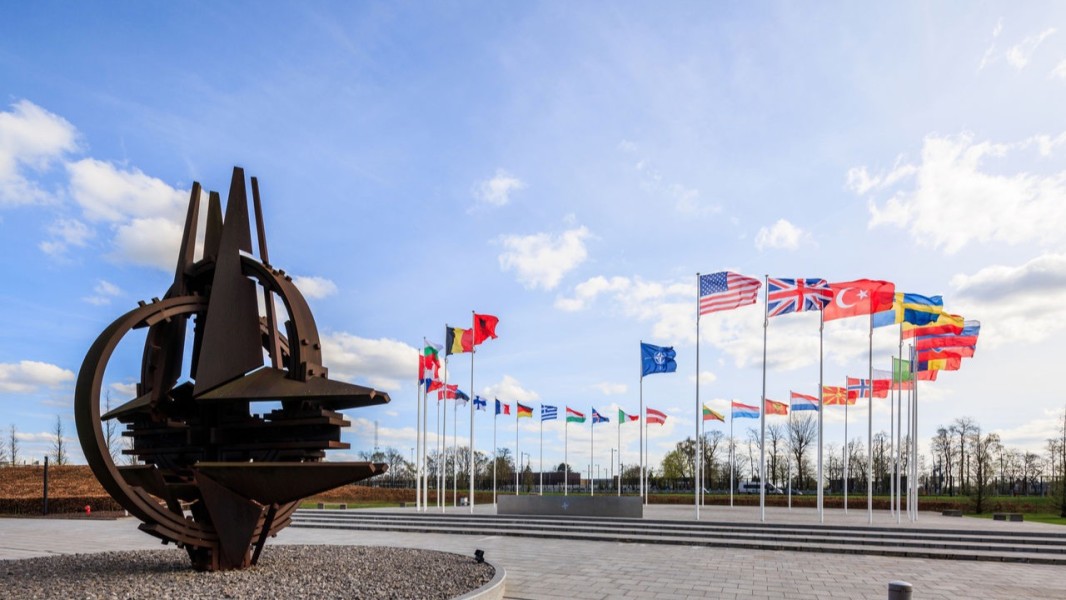
    This article reflects only the views of its author. Article originally published in French on LinkedIn on 20 February 2026. Photo credit: NATO.

    This article was translated from French by Claude (AI), including quotations from French-language sources. In case of any discrepancy, the French version prevails.

  • Key takeaways from the 2026 Munich Security Conference: Alexandre Vulic’s view

    Key takeaways from the 2026 Munich Security Conference: Alexandre Vulic’s view

    Since 1963, the Munich Security Conference has brought together leaders from NATO and EU countries and from around the world every February to debate the defence of Europe, transatlantic relations and major international security issues.

    Three AFCEA members attended the 2026 edition: Alexandre Vulic, Élie Tenenbaum and Camille Grand. Alexandre Vulic, a diplomat specialising in defence issues in multinational settings, shares the key takeaways.


    1. The change in the transatlantic relationship – not to say the rupture – introduced at the February 2025 conference, notably by the speech of US Vice President James D. Vance, was confirmed by the speech of US Secretary of State Marco Rubio and the messages of Elbridge A. Colby, US Under Secretary of War, in line with the new American security and defence strategies: from “burden sharing” to “burden shifting”. Many European Allies nevertheless want to see it as a message of reassurance and pretend to see in it a certain normalisation promising renewed cooperation.

    President Macron’s message on the need for Europeans to redouble their efforts with self-confidence was all the more important in this context: this is no time for illusions, but for consolidating a responsible and autonomous European path to meet the demands of the new relationship and ensure its stabilisation. Beyond the applause, however, this speech is probably not enough to convince people that it will be put into practice, at a time when France’s room for manoeuvre is seen as limited and constrained by the 2027 political deadline.

    All in all, although it endures, the transatlantic bond is changing structurally, and interests, well or poorly understood, now take priority over values – whereas the opposite is true in Europe. This is also why there is no cause to rejoice at the Alliance’s evolution since President Trump entered the arena: the unity of the West, which has value in itself, is no longer self-evident and, judging by Rubio, who nonetheless invokes it, no longer rests either on a common purpose or on power in the service of peace and security. We will miss these two foundations all the more since it is hard to see how appeasing Russia through a hypothetical ceasefire agreement in Ukraine could persuade China to be more circumspect and moderate in Asia. The opposite seems more likely.

    2. The complementarity between Chancellor Friedrich Merz’s speech and President Macron’s was all the more noticed and appreciated as it signals a mutual Franco-German understanding at a time of challenges and slowdown for a relationship that remains structural for Europe: Federal Chancellor Merz acknowledged the end of yesterday’s transatlantic world, while the French President set out the path of a Europe of power in the making, building on what it has achieved. The European role of French deterrence attracted renewed interest, and Emmanuel Macron’s announced speech on 27 February will be eagerly awaited. Nuances and differences over the industrial conditions of defence ambitions nevertheless remain intact and clearly sensitive, as shown by the prevailing scepticism about the Future Combat Air System (FCAS) and the way the Germans seem to consider that France no longer has the means to impose its conditions on their own industry, given France’s lower investment capacity.

    3. And what about the world’s hotspots? Facts are stubborn: Ukraine remained the dominant topic, despite the Munich Security Conference’s ambition to foster a global dialogue and a discussion on China. President Volodymyr Zelensky stayed for 36 hours, gave a widely noted speech and received the Ewald von Kleist Award. His delegation made full use of the platform it was offered – with an entire building (“Ukraine House”) hosting an exhibition on the role of defence technology innovation against Russia, notably Ukrainian-made drones, the pursuit of peace through strength and the “defence of defence”. A way of sending a double message: without a just peace and a sufficiently credible deterrent against Moscow, danger and uncertainty in Europe will remain such that it will be difficult, on both sides of the Atlantic, to mobilise all the energy and resources needed to face other challenges; and without sufficient innovation and adaptation by NATO Allies to the new methods of confrontation seen in Ukraine, the danger is likely to grow, as the lessons of the Alliance’s Hedgehog 2025 exercise recently revealed.

    On the Middle East, the presence of Reza Pahlavi (accompanied by demonstrations of support from the Iranian diaspora in central Munich) was noted.

    This Munich Security Conference also gave unprecedented space to defence technology innovation, with a great many side events devoted to the subject. The Ukrainians highlighted this in particular.

    Bavaria, home to a third of Germany’s defence industry and positioning itself to attract German and European investment, has just inaugurated a defence innovation centre near Munich, which could foreshadow a German or even European defence innovation agency.

    We see this as a promising avenue: prioritising Franco-German cooperation on defence technology innovation could make it possible to commit further on a necessary and less politicised subject than FCAS. It is also, starting now, an invitation to bring more French companies into a German defence ecosystem that is growing and innovating all the faster because it relies on the response of innovative industries.

    Alexandre Vulic


    This article reflects only the views of its author. Article originally published in French on LinkedIn on 19 February 2026.

    This article was translated from French by Claude (AI). In case of any discrepancy, the French version prevails.
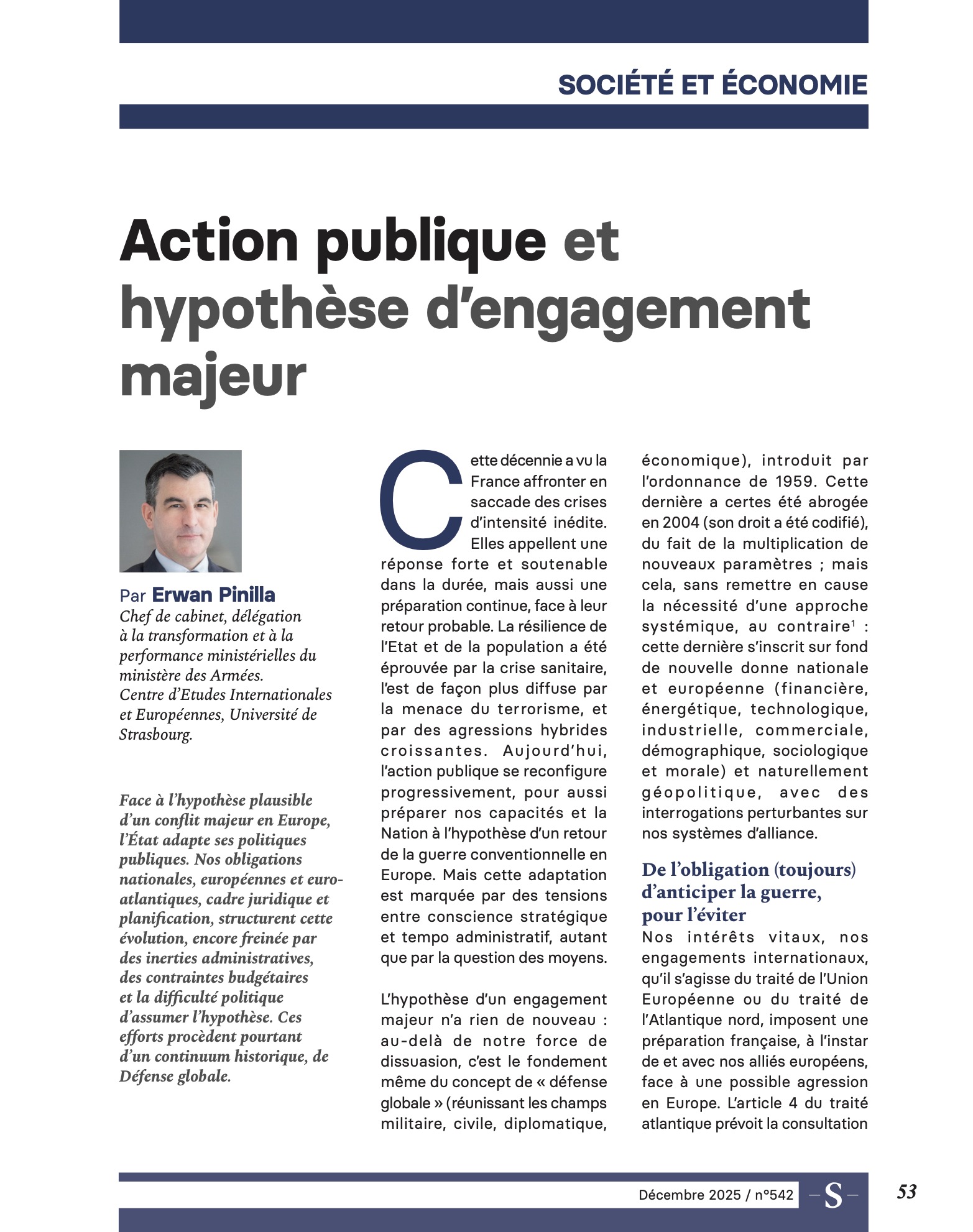
  • Erwan Pinilla in issue 542 of the journal “Servir” – December 2025

    Erwan Pinilla in issue 542 of the journal “Servir” – December 2025

    Faced with the plausible prospect of a major conflict in Europe, the State is adapting its public policies. Our national, European and Euro-Atlantic obligations, legal framework and planning shape this evolution, which is still held back by administrative inertia, budgetary constraints and the political difficulty of acknowledging the scenario. Yet these efforts are part of a historical continuum, from Global Defence…

    Read Erwan Pinilla’s full article (in French):

    This summary was translated from French by Claude (AI). In case of any discrepancy, the French version prevails.
  • Frédéric Pesme: “Europe: preparing for the coming war, without the Americans”

    Frédéric Pesme: “Europe: preparing for the coming war, without the Americans”

    Since 2014, and even more so since 2022, Europeans have profoundly revised their approach to defence. The prospect of a major conflict on the continent, long considered unlikely, is now part of political and military discourse. Several European leaders openly mention the possibility of a war with Russia in the coming years. While scenarios differ, a consensus is emerging: Moscow could regain a significant offensive capability within five years.

    This threat comes against a backdrop of deteriorating transatlantic relations. The US National Security Strategy (NSS – 2025), followed by the National Defense Strategy (NDS – 2026), insist that Europe must now shoulder a much larger share of the security burden, and they heighten the ambiguity about Washington’s attitude in the event of a conflict in Europe. This ambiguity was revived by the way European Allies were treated during the Greenland crisis, which raises questions about the real hierarchy of American priorities and about the future of NATO.

    Europeans, who outsourced their security for decades, must therefore prepare to take on more responsibility, which means acquiring the capabilities they lack.

    This extract was translated from French by Claude (AI). In case of any discrepancy, the French version prevails.
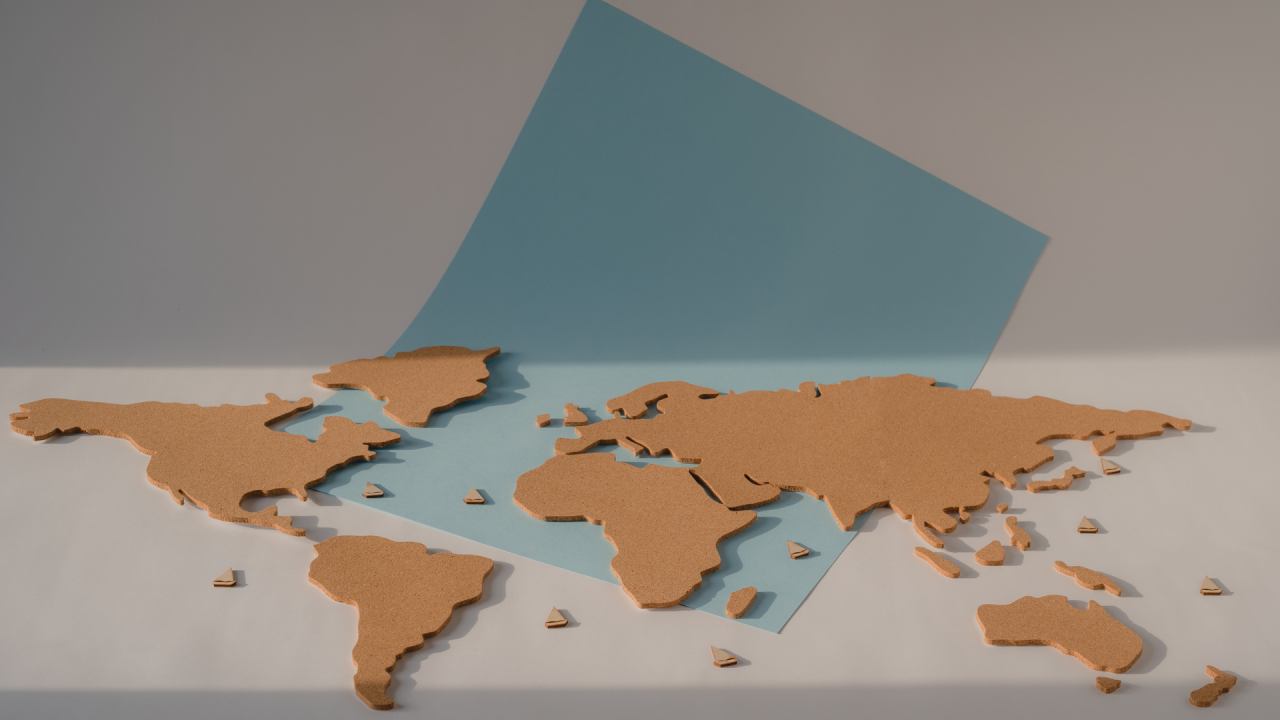
  • 2025 : A Geopolitical Year

    2025 : A Geopolitical Year

    Benjamin Ducos, August 2025

    Amidst a year 2025 repeatedly described — ad nauseam — as being profoundly geopolitical, what is the reality? This reflection examines the first seven months through a gallery of portraits, ranging from diplomats to insurers.

    Undoubtedly, 2025 has been a tumultuous year for diplomats who have followed polling data and analyzed election results across nearly all continents. Notable cases include Lebanon (January 9), where deputies elected Joseph Aoun, commander-in-chief of the army, to the presidency after two years of vacancy. In this Cedar-rich country, tragically scarred by clan warfare, regional ambitions, and destabilized by Hezbollah, Prime Minister Nawaf Salam faces significant challenges — yet, does he possess the means to succeed? Another partly francophone nation, Canada (April 28), saw Liberal candidate Mark Carney triumph over Conservative rival Pierre Poilièvre, who was disadvantaged by the influence of the American neighbor, Donald Trump and its pro-integration tendencies with the United States.

    In Germany (February 23), Friedrich Merz was elected Chancellor amidst the collapse of Olaf Scholz’s coalition government (SPD), which lost the confidence of the Bundestag. In Romania (May 4 and 18), the core issues of European integration, NATO membership, foreign interference, and the country’s stance on the Russia-Ukraine conflict dominated the electoral debate, resulting in Nicusor Dan’s victory by a seven-point margin over George Simion. As expert Catherine Durandin notes (Diploweb.com, May 2025), “In 2025, with Nicusor Dan’s election, the question arises: which page has been turned?” Finally, in Poland (May 18 and June 1), nationalist and conservative candidate Karol Nawrocki narrowly won the presidency against liberal candidate Radoslaw Trzaskowski. The real story here is the cohabitation between the sovereigntist president and the liberal Prime Minister Donald Tusk — a relationship that warrants close scrutiny.

    In Asia, South Korea (June 3) elected Lee Jae-Muyng in a snap presidential poll following martial law declared in December 2024 and the ousting of President Yoon Suk-yeol. Jae-Muyng might play a more proactive role than his predecessor, especially in the context of Trump’s ambition to rekindle peace negotiations with North Korean dictator Kim Jong-un.

    Furthermore, as anticipated, Donald Trump’s inauguration (January 20) marked the decline of traditional diplomacy: barely settling into the Oval Office, the U.S. president engaged in a diplomatic standoff with Europe, articulated geopolitical ambitions over Panama, Mexico, and Canada, and humiliated the Ukrainian president. In essence, Trump is reconstructing the world around America’s centrality with short messages on his favored social network, grandiose boasts, and some notable successes — though their durability remains uncertain to many observers.

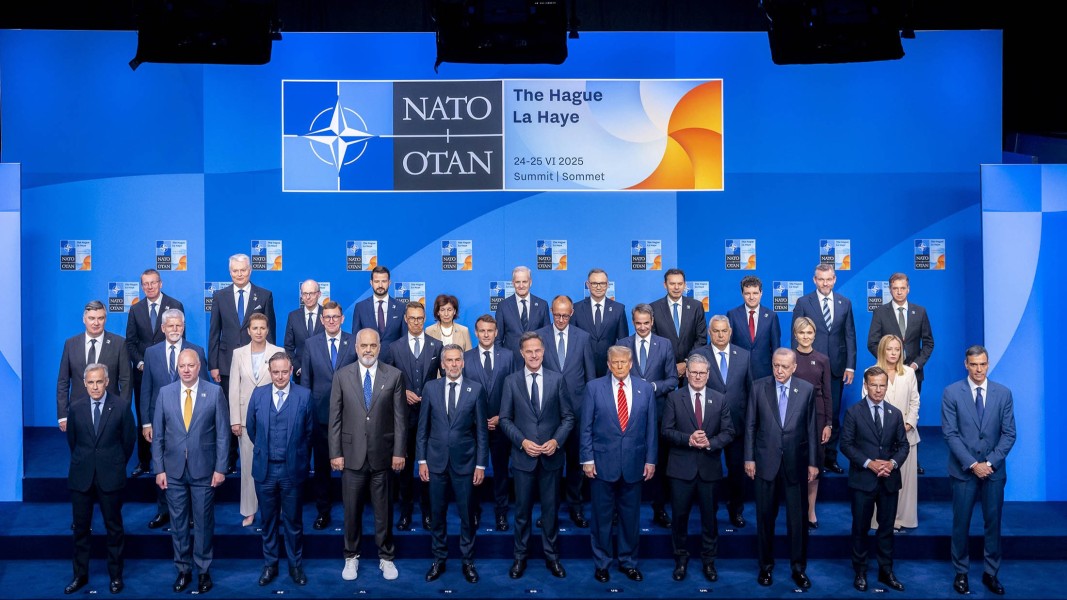
    Another illustration, not on the electoral front but within the realm of alliances, was the NATO summit in The Hague (June 24–25). The first since Trump’s return to the White House, it saw alliance members urged to increase defense spending — Trump repeatedly stated he would not “protect” NATO members who did not “pay their bills,” demanding that defense expenditures reach 5% of GDP, while many European countries struggle to reach 2%. Trump’s approach — imposing his pace, financial demands, and strategic priorities — demonstrates that “Europe’s defense remains under NATO’s tutelage, under Washington’s oversight” (Axelle Degans, Diploweb.com, June 2025). However, awareness is gradually growing among leaders and the public of the precariousness of this arrangement and the urgent need to address it. The lesson delivered on February 14 by Vice President Vance at the Munich Security Conference — highlighting the significant gap in “shared values” — underscores this reality.

    The military sphere has also been active since Trump’s second term, at the beginning of 2025. In the Middle East, following Israel’s large-scale offensive in Gaza in April 2025 (dubbed the “Twelve Days War”), Trump authorized American strikes on Iranian nuclear sites (Fordo, Natanz, Isfahan) in support of Israel, employing B-2 bombers and GBU-57 bombs. Named Operation Midnight Hammer, this retaliated against Iran’s increased uranium stockpiles and centrifuge advancements, pushing the country closer to nuclear capability.

    Despite claiming to be a “peacemaker,” Trump also convened Armenian and Azerbaijani leaders at the White House to broker a resolution to their longstanding conflict — exerting influence through both forceful rhetoric (“You will have a very good relationship,” Trump reportedly told the guests, adding “If not, call me and I’ll fix it”) and economic leverage. Yet, as always, key subtleties — such as the status of Nagorno-Karabakh/Artsakh — are conveniently omitted.

    In Ukraine, military analysts observe a confirmed return to high-intensity combat, marked by increased frequency and a concentration of combined drone and missile attacks. Russian Armed Forces maintain a dominant position, gaining territory in sectors like Koursk and Soudja. Meanwhile, Russia targets civilian infrastructure through deadly strikes in Kyiv and Dnipro, while Ukraine continues its strategy of targeting Russian logistical hubs, armament depots, and fuel supplies — evident in the extensive strikes in March. 

    Notably, the massive operation on June 1 targeted Russian airbases housing strategic aviation, with BBC’s Paul Adams describing the attack as “bold and innovative.” Yet, months after this success, the situation remains largely unchanged, and Zelensky finds himself returning — when invited — to discussions and moments of diplomacy involving Trump and Putin.

    In Africa and Asia, CEOs faced strategic obstacles. In Africa, regional political developments and mineral conflicts disrupted development plans. The Economic Community of West African States (CEDEAO / ECOWAS), led by Nigeria, Benin, Ivory Coast, and Senegal, threatened military intervention in summer 2023 against Niger’s coup leaders unless President Bazoum was restored. Subsequently, Burkina Faso, Mali, and Niger, along with Chad, withdrew from ECOWAS in January 2024, forming the Alliance of Sahel States (AES). These militaries, in power in Mali, Burkina Faso, Niger, and Chad, severed alliances first with France, then the United States, shifting closer to Russia — favoring the private military company Wagner over Western military presence. This shift led to the departure of troops from Burkina Faso, Mali, Niger, and Chad, and later Senegal. In January 2025, Ivory Coast announced a “coordinated and organized” withdrawal of French troops. As a result, European companies that relied on French military protection saw this shield withdraw, with French troops now only stationed in Gabon and Djibouti.

    Economically, the military juntas in Burkina Faso, Mali, and Niger endowed their Confederated Bank for Investment and Development (BCID AES) with 500 billion CFA francs (around €760 million), potentially laying the groundwork for a currency replacing the CFA franc. The mineral war persists, particularly in the Great Lakes region, where Rwanda, lacking the mineral wealth of its neighbors, already exploits Congolese gold mines and eyeing tin, tungsten, and coltan — vital for electronics industries — originating from North Kivu’s vast reserves.

    For CEOs with operational or industrial interests in Asia, prospects darkened due to Indo-Pacific tensions.

    The border disputes between Thailand and Cambodia exemplify the strategic rivalry between China and the U.S., which also involves France. China, seeking to impose “its” maritime domain with a line of more or less nine dashed claims, has “classified water resources as a national security issue, betting on hydroelectric potential — posing risks for neighboring countries such as India” (as Franck Galland notes in Diplomatie, June 2025). Conversely, Indonesia — a “little-known giant” (Jean-Baptiste Noé, Conflits, July 2025) — maintains neutrality by purchasing fighter jets from China, Russia, the U.S., and France. In this contested maritime space, “the strategic rivalry between the U.S. and China is intense — subtle yet pervasive”.

    During summer, the ambiguity of the boundary established by the 1907 Franco-Siamese treaty, which demarcates frontiers between Siam (Thailand) and French Indochina (Cambodia, Laos, Vietnam), triggered escalation, resulting in exchanges of fire that caused over forty casualties. Though a ceasefire was agreed upon after four days, such border skirmishes will likely recur as long as these ambiguities persist.

    In the first half of 2025, many Production or Procurement heads have seen their logistical plans disrupted. Supply chain security has become more critical than ever, yet it remains difficult to design and sustain in a world where globalization is challenged by geopolitical risks.

    For example, in April 2025, twenty Indian tourists were killed in Kashmir. India responded, and the two nuclear powers — India and Pakistan — clashed anew, reminiscent of their three wars over Kashmir. This heightened tension raised concerns about the operations and supply chains in India, one of the world’s largest manufacturing hubs. The U.S. intervention led to a ceasefire on May 10, restoring temporary calm.

    For Production and Procurement heads, uncertainty — more than sudden shortages of energy, raw materials, or components — is the greatest risk. This uncertainty was vividly illustrated by the sudden imposition, negotiation, and reimposition of high tariffs by the U.S. administration within days, disrupting flows and prosperity. In France, the MEDEF’s call in November 2024 for businesses to “secure their value chains” takes on particular urgency in this volatile context.

    It also serves as a reminder for organizations with high supplier exposure, especially those subject to DORA regulation effective January 2025, which require from financial services implementing governance, policies, and measures to manage third-party risks more effectively. These measures enable such companies to respond swiftly and structurally to geopolitical shifts that alter sources and routes of raw materials, technologies, and services.

    In this respect, at the beginning of 2025, we saw the United States’ eagerness to impose on Ukraine an agreement to create a joint investment fund for the exploitation of Ukrainian natural resources, initially presented by Donald Trump as compensation for the aid provided by Washington to Kyiv in the war against Russia: this was done at the risk (and with the clear intention) of upsetting previous or parallel agreements with other state or private actors.

    More broadly, oil remains the quintessential geo-economic and geopolitical weapon. This is exemplified by OPEC+’s manipulation of oil price — most notably, in May 2025, when members — Saudi Arabia, Algeria, United Arab Emirates, Iraq, Kazakhstan, Kuwait, Oman, Russia — increased oil production, directly contributing to a decline in crude prices to 2021 levels. These nations aim to shield themselves from sanctions on Iran and Venezuela and challenge U.S. producers’ profitability to gain market share.

    Western operations targeting Houthi positions in Yemen further illustrate the complex nexus of regional conflicts and the need to secure oil routes and infrastructure. During the Israel-Iran “Twelve Days War,” the Strait of Hormuz became a critical vulnerability within hours, with the narrow passage — around thirty kilometers wide — becoming a potential choke point that must be protected at any cost, including militarily, due to the significant share of global oil transit passing through it. Gilles Moec, AXA Group Chief Economist, already emphasized back mid 2024 that “Navigating this fragmented world will entail a lot of agility for global companies”. He insists on the need for companies to think about the location of their production centers “not only in terms of cost and proximity to markets, but also political alignment” and consider “diversifying suppliers across geographies to minimize the risk of sudden stops in trade flows.”

    In closing, a word for insurers supporting companies and organizations facing increasing risks and uncertainties: undoubtedly, 2025 has begun as a notably geopolitical year.

    Through its advice and independent risk analysis, the insurer has often served as a bridge connecting the diplomatic, military, economic worlds, and the leadership of major organizations and operational heads. Its guidance on investment optimization, operational risks, supply chain security, travel assistance, cybersecurity, and executive liability — among other areas — are deeply intertwined with geopolitical issues.

    The 2024 Future Risk Report issued by AXA highlighted that 91% of the experts but also 72% of the general public believe that insurers’ role in safeguarding against emerging risks will be crucial in the future: through their advanced models and data analytics, insurers can help quantifying and evaluating emerging risks, and can apply their expertise to assist individuals, businesses, and the public sector to enhance their resilience to a range of emerging risks including geopolitical risks.

    In a world marked by polycrisis — where great powers clash in high-intensity wars with heavy human costs (Sudan, Ukraine…) and indirect proxy actions — the geopolitical factor is poised to remain highly relevant. In 2025 and beyond.

    Benjamin Ducos is an associate teacher in Security and Crisis management at Sciences Po (France). He serves as Group Head of information risk management at AXA, an insurance world player.

  • NATO: an organisation like any other?

    NATO: an organisation like any other?

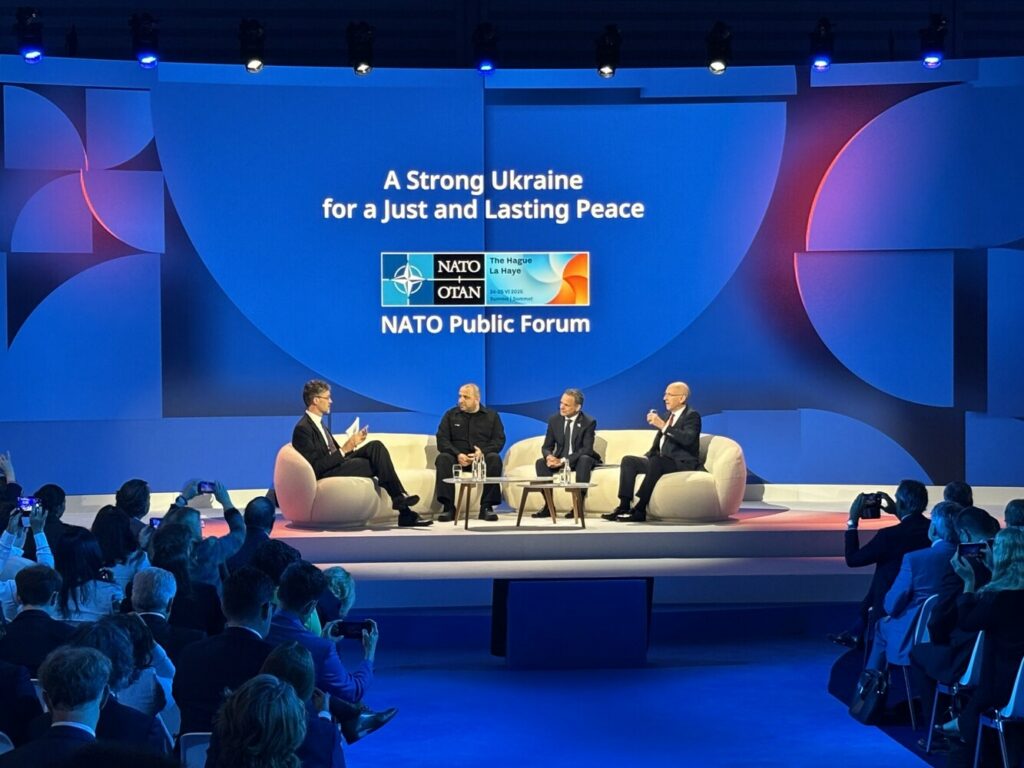
    On 24 and 25 June, the NATO Summit was held in The Hague. Invited to take part in the “Public Forum”, which brought together some 500 to 600 participants in a neighbouring building, within the same perimeter and with some of the same speakers, I was able to take a close look – with my eye as a practitioner of collective dynamics – at a key event in the life of the North Atlantic Treaty Organization.

    As I write these lines – barely two weeks after the Summit – nobody outside specialist circles is talking about it any more. We have moved on to the heatwave, tax policy, the misdeeds of foreign governments… while waiting for the beach weather report, after the baccalauréat results.

    This is not surprising. And just as well, because this ability to move from one news item to the next – always bad news, though, because that is what draws an audience – reflects the collective resilience of our societies.

    What is more worrying is the choice of angles in the coverage of the event: money and leaders’ posturing… Is the Atlantic Alliance an organisation like so many others, driven solely by financial flows and the spotlight?

    The Public Forum, a formidable “coffee machine”

    First of all, what is the “Public Forum” organised by NATO alongside the North Atlantic Council, to which I was invited on behalf of an association in which I take part with others?

    It is a two-day public relations event that brings together researchers, experts, journalists, current or future opinion leaders, “engaged citizens”… to take part in debates with high-level speakers, get to grips with the issues of the moment and, above all, talk to each other.

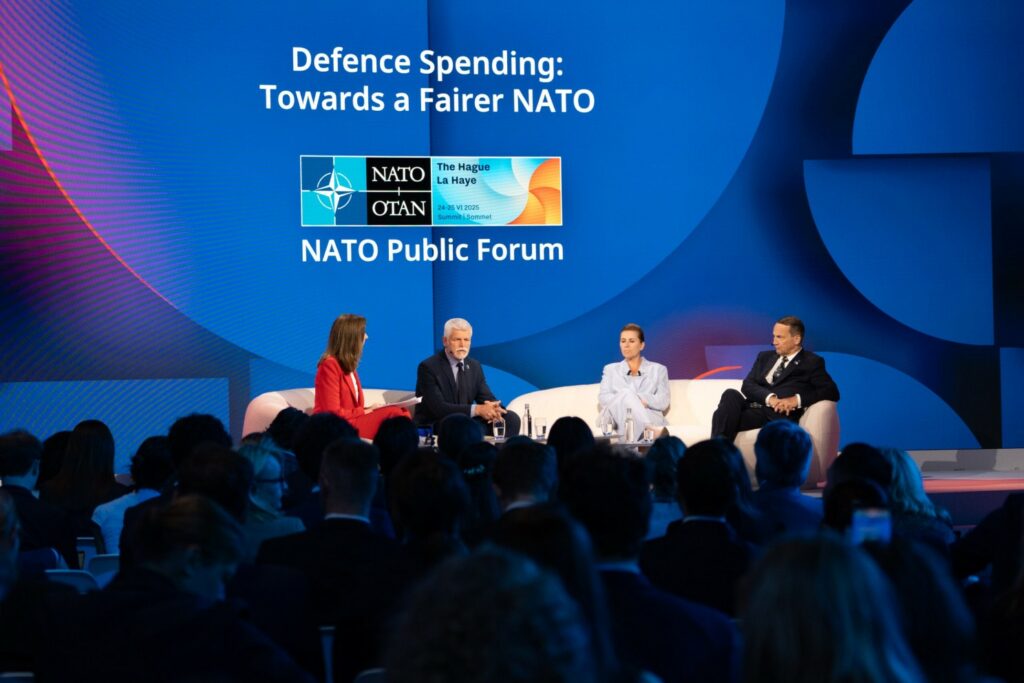
    A round table at the Public Forum of the NATO Summit in The Hague, June 2025
    A round table at the “Public Forum” (photo credit: NATO)

    For, as a well-known French podcaster, also invited and attending for the first time, remarked, “people spend their time talking to each other”. To which one of his interlocutors, a distinguished and very experienced expert on these meetings, replied: “indeed, we all more or less know each other”…

    As an outsider, however, I noticed that in practice they did not all really know each other. They knew each other, certainly, but within given circles. And there was little, if any, porosity between the different environments.

    I immediately drew the parallel with the “grand gatherings” some large companies organise.

    You sit quietly in the room and listen to speakers who have more or less prepared their remarks, “reeling off” all-too-familiar talking points or, fortunately, making real contributions to the debates of the day – when there is a debate.

    Then, at the coffee break or buffet, you naturally head towards your colleagues… Because you know them, and also because, professional life being what it is, you make the most of these “coffee machine” moments to deal with ongoing matters, clear up questions, and set up meetings you had not managed to arrange…

    Some take the opportunity to “network”, or to approach figures they would not have dared or been able to contact online… But for that, you need to have prepared these contacts, or keep a close eye on name badges – or, in this politico-military setting, on uniforms, which can make identification and therefore contact easier.

    But participants are not always open to new approaches – out of personal preference, but also no doubt, given the particular context, out of professional caution.

    Human nature is what it is. People stay above all “among their own”. And that is fine too. Even if developing collaboration or, at the very least, better mutual knowledge could also be one of the expected outcomes of such moments (yes, I am also a “facilitator of collective dynamics”, and I admit it gives me a particular perspective…).

    Naturally, because my motto is “helping you work better together” in all circumstances, I tried to spark a few contacts between people from different circles… But I also had my own connections to make or renew, and the conferences followed one another at a steady pace. It was therefore difficult to facilitate introductions. After the initial contact between the parties, things rarely click spontaneously, and some energy always has to be put in! Of course, it would have been possible to “twist” the overall organisation a little, but everything was meticulously planned and secured… Something to plan for next time?

    My various contacts also confirmed this “coffee machine” benefit… the one that explains why remote work has never been able to replace daily interactions, at least for professions that also need others in order to “produce” (and who doesn’t, really?). And why many companies are revisiting their remote-work agreements, beyond any desire for “control”.

    For while experts paid very close attention to certain key statements – those for which speakers had invested preparation time, not just attendance time – most participants fully embraced the fact that they were there to see each other, be together and talk. Really. And even, regarding those key statements, to discuss them afterwards and fully take them on board.

    The NATO Summit: a platform or a revealer?

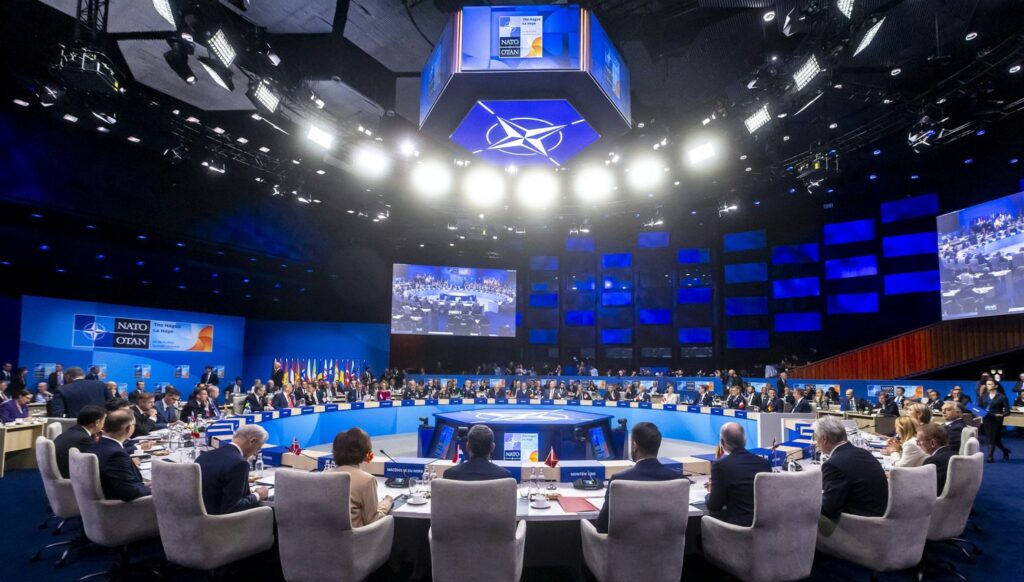
    The North Atlantic Council meeting in The Hague, June 2025
    The North Atlantic Council meeting in The Hague (photo credit: NATO)

    Back to the Summit itself…

    “Summits” are meetings of the North Atlantic Council at the highest level of the Atlantic Alliance: that of Heads of State and Government.

    So why “Summit”? Partly, no doubt, because it sounds better than the official name… and also because other meetings are held in parallel (in The Hague, in addition to the Public Forum, there was a forum on armaments, bilateral and multilateral meetings such as the E5, an official reception at the Royal Palace, and events organised by think tanks…).

    These Summits are not held at regular intervals, but according to the events the Atlantic Alliance faces and the decisions to be taken.

    The calendar of past meetings is instructive, as it reminds us of the rhythms of this world (at least of our world, in the Euro-Atlantic area).

    After the founding in 1949 (yes, time flies…), there were Summits in 1957, 1974, 1975, 1977, 1978, 1982, 1985, 1988, 1989 (May and December), 1990, 1991, 1994, 1997 (May and July), 1999, May 2002, November 2002, 2004, 2005, 2006, 2008, 2009, 2010, 2012, 2014, 2016, 2018, 2021, 2022 (February, March, June), 2023, 2024 and now June 2025…

    And as with all major events of multinational companies, there are rarely surprises at the meetings themselves (because nothing is decided in a meeting; you only formalise decisions taken during the preparation, right?).

    At least, as in company events that value smooth functioning.

    The public exposure is sometimes used to give a decision more resonance. But “normally”, no member of the management or board takes advantage of the moment to surprise colleagues or force their hand…

    For NATO, it is both the same and different.

    Because one of the specific features of this organisation is that it operates strictly by consensus! And, in principle, consensus also requires a certain respect for different points of view… In principle only, since playground-bully behaviour can, it seems, occur – or at least be feared.

    In companies – especially the largest ones – even-tempered behaviour is also expected.

    But deviations can occur. A “charismatic” leader who is feared (once there is fear, this is in reality a “toxic” leader), an operational or functional executive whose whims are tolerated because of indispensable expertise or exemplary results (as long as the negative cost of their actual behaviour is ignored)… It can happen, but it never lasts long.

    At least not when these practices are public, because they affect the image of the collective, and therefore the image of each member and the relations between them all – who may then organise a response.

    And it never happens when the company’s “governance” rests on a relative balance of power between the various stakeholders. A balance of power that keeps the organisation on course despite the bumps of life and context – one of the organisational benefits of this type of structure.

    Collective functioning thus normally guarantees the absence of surprises – except when everyone agrees to let the bully take the lead, as soon as he benefits from an absence of balance of power.

    He can then use the event as a platform to deliver – or have others deliver – a message, explicitly or implicitly. And turn the event into a revealer of how things really work. Which one may or may not be satisfied with.

    These effects can allow some – competitors or adversaries – to discredit the organisation in the eyes of a general public that knows nothing of its strengths, the subtleties of its functioning and its ability to pull itself back on track, beyond the tribulations of “the society of the spectacle”.

    NATO: an organisation with a board of directors

    Some people are unaware of it: the North Atlantic Treaty Organization is a politico-military organisation.

    When people talk about NATO, they think first of the military means the Alliance can deploy, but it is also, and above all, a political organisation. With a “board of directors” – the North Atlantic Council, meeting at the level of Heads of State and Government, or in more “technical” formats (Defence Ministers, Foreign Ministers).

    The Military Committee is the advisory and executive body, on which the armed forces of each member country are represented (except Iceland, represented by a civilian as it has no armed forces).

    The permanent delegation, headed by an Ambassador, carries out the mission its name clearly expresses, both within the North Atlantic Council and the Military Committee.

    Of course, all this involves a lot of people: the staff (civilian and military) provided by each member country and the 6,500 staff directly employed by the organisation to run this “bureaucracy” (with no negative connotation).

    6,500 people is both a lot and very little for an international organisation, isn’t it?

    At the head of this bureaucracy is a post with a very particular role: the Secretary General.

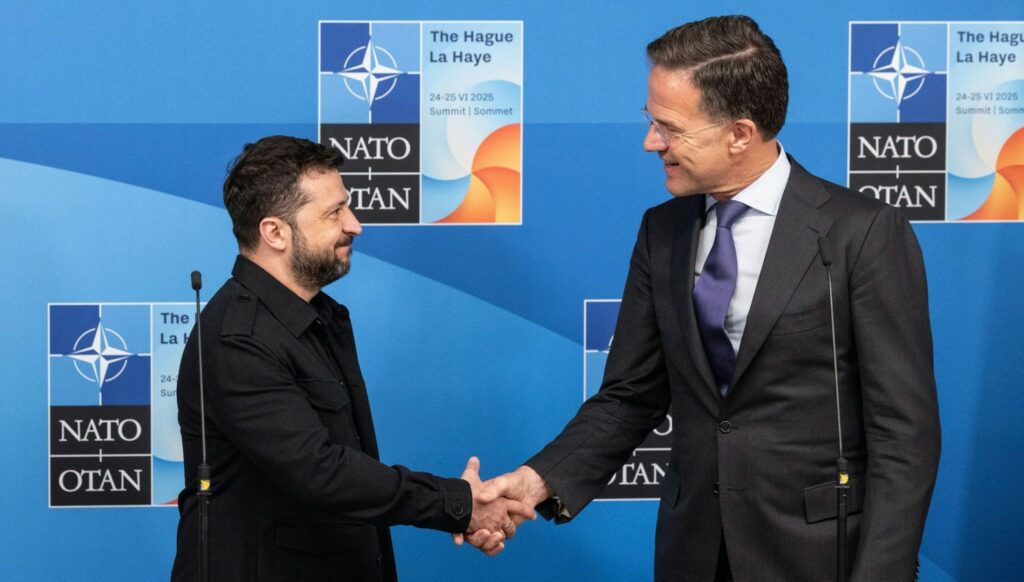
    Ukrainian President Volodymyr Zelensky and NATO Secretary General Mark Rutte
    Ukrainian President Volodymyr Zelensky and NATO Secretary General Mark Rutte (photo credit: NATO)

    Under the authority of the North Atlantic Council (this very particular collective governance), his tasks include running, with his specialised deputies, the many committees, and also helping the Council reach the famous consensus…

    Compared with civilian organisations, this is therefore a particular way of functioning, but not so very different.

    The Secretary General is in charge of the “executive committee”. But he is also responsible for helping the “board of directors” find common positions – all the more so as it has no Chair and brings together 32 members…

    To those who argue that consensus is not an effective method, I would recommend listening to Admiral Vandier, one of NATO’s two strategic commanders, in charge of preparing for the future, in one of the post-Summit episodes of the essential podcast “Le Collimateur”(1). He points out that while consensus is difficult to achieve, nobody can then disown the decision taken… which may inspire some civilian business leaders confronted with implementing decisions taken without real commitment from stakeholders.

    And to come back to The Hague Summit, one of the stated objectives was to secure a united “family photo” despite the tensions… An objective achieved by the members of the “board of directors” – the North Atlantic Council – whatever the criticism, possibly justified (but it was no easy task), of the style adopted by the “chief executive”.

    Here again, as in a more conventional organisation, who should be praised and who blamed?…

    NATO: a lack of means, or a lack of meaning?

    In the days following the Summit’s final declaration, what we mostly heard about was budgets. The famous “5%”, signifying acceptance of – or even submission to – the American President’s demands.

    In a recent episode of the podcast “Le monde selon l’IFRI”(2), Elie Tenenbaum explains very clearly where this 5% comes from and what it is…

    Many people confuse, deliberately or not, NATO’s budget with defence budgets.

    NATO’s budget – what allows the organisation to function – is around 4.6 billion euros a year. That is the operating budget of the Île-de-France region, and less than that of the Auvergne-Rhône-Alpes region.

    This budget is shared among member states according to a fixed cost-sharing formula, which was adjusted when Finland and Sweden joined the Alliance in 2023 and 2024. France’s share is 10.19%, while that of the United States is 15.88%.

    The famous “5%” is the estimated financial effort each member state should make (in percentage points of GDP) for its own defence. And of this 5% target, 3.5% is for purely military spending, while 1.5% is for “resilience”-related projects.

    Budgets for their own defence, for their own security. For capabilities they will pool, partly or more fully, to be more effective, more credible and more resilient.

    But 5% of GDP sounds like billions of hard euros (and dollars)… It speaks the language of billionaires and fundraisers, as well as of many political decision-makers.

    But have we not forgotten the “why”?

    Round table with the Czech President, the Danish Prime Minister and the Polish Foreign Minister
    One of the round tables, with the Czech President, the Danish Prime Minister and the Polish Foreign Minister (photo credit: NATO)

    As Elie Tenenbaum patiently explains in the podcast episode mentioned, this figure is the result of an assessment of military requirements.

    And these military requirements are those deemed necessary to deter, or even confront, a clearly identified threat: the stated will of Vladimir Putin’s Russia to pursue its territorial expansion in order to restore the borders of the Soviet Union of his KGB youth – as well as its will to destroy the European Union, a potential power capable of challenging its continental hegemony.

    This is also what the President of the Czech Republic, Petr Pavel, recalled from the Public Forum stage: the question is not the size of the budget, but the operational effect sought. And he speaks from experience: before being elected Czech President in 2023, he was Chief of the Czech General Staff from 2012 to 2015 and Chairman of the NATO Military Committee from 2015 to 2018.

    By talking only about budgets, we forget the meaning. And business leaders know this well: you do not mobilise people with spending (or savings) figures, but by explaining why, and by deciding what and how.

    It is also this lack of meaning that makes decisions difficult. Because there are many urgent needs: maintaining social cohesion, preserving our way of life, investing in the future, and also working on the ecological transition so that the war in the East is not compounded by the climate war, which has already begun…

    Trade-offs will have to be made. But the question will not just be how much. It will be why.

    So what if we, as business practitioners, helped our political and military leaders explain the why, and involve us in the decision-making process?

    Alexis Kummetat

    The two podcast episodes cited (in French)

    1. Le Collimateur, “Planifier l’avenir de l’Alliance” (Planning the Alliance’s future), 25 June 2025, Alexandre Jubelin, Admiral Pierre Vandier.
    2. Le monde selon l’IFRI, “Trump, l’OTAN et la défense de l’Europe” (Trump, NATO and the defence of Europe), 7 July 2025, Marc Hecker, Elie Tenenbaum.

    This article reflects only the views of its author. Article originally published in French on LinkedIn on 7 July 2025. Illustration: the Heads of State and Government of the Atlantic Alliance (photo credit: NATO).

    This article was translated from French by Claude (AI). In case of any discrepancy, the French version prevails.
  • A Transatlantic Defense Industrial Base? Two contrasting views

    A Transatlantic Defense Industrial Base? Two contrasting views

    A two-author debate to which Elie Tenenbaum contributed. An IFRI study (in English).

    https://www.ifri.org/en/studies/transatlantic-defense-industrial-base-two-contrasting-views

    This introduction was translated from French by Claude (AI). French version.

  • The return of the nuclear question

    The return of the nuclear question

    An interview with Camille Grand on 10 March on Europe 1 (in French).

    https://www.europe1.fr/emissions/L-interview-de-7h40/camille-grand-il-y-a-un-retour-du-debat-nucleaire-667299

    This introduction was translated from French by Claude (AI). French version.