Cognitive warfare: a new concept for old practices
As confrontation spreads into new spaces, perceptions, reasoning and decision-making mechanisms themselves tend to become targets. It is precisely in this transformation of the human mind into a genuine battlefield that the logic of cognitive warfare lies.
Broadly understood, cognitive warfare aims to influence, alter or even destroy an adversary’s representations and thoughts, notably by exploiting their cognitive biases, psychological vulnerabilities or emotions. Without being entirely the same as psychological and information warfare, it tends to extend them and incorporate some of their methods.
In this context, the cognitive dimension has gradually found its place in the thinking carried out within the NATO ecosystem, in particular by Allied Command Transformation (ACT) and its Innovation Hub. Without necessarily amounting to a doctrine officially adopted by all Allies, this work reflects a real effort of conceptualisation and adaptation, as illustrated by the report published in 2020 by NATO ACT’s Innovation Hub, entitled “Cognitive warfare. An attack on truth and thought”. According to this report, cognitive warfare is “the weaponization of public opinion by an external entity, for the purpose of (1) influencing public and governmental policy and (2) destabilizing public institutions”.
The desire to influence an adversary’s thinking and exploit their cognitive mechanisms to gain the upper hand is not a new practice. Cognitive warfare thus builds on long-standing methods, which calls for caution towards claims presenting it as an entirely unprecedented form of conflict. It has, however, taken on a new scale and new forms in recent years, mainly as a result of new technologies and the rise of social media.
From conceptualisation to NATO’s institutional adaptation
Beyond the exploratory work of ACT’s Innovation Hub, the cognitive dimension is gradually being taken into account institutionally within the Alliance. This does not mean, however, that the cognitive field has so far been officially recognised as an operational domain in its own right. NATO still distinguishes five operational domains: land, air, maritime, cyber and space, the latter recognised as the fifth domain in 2019. The cognitive dimension is therefore approached transversally, at the crossroads of hybrid and information threats.
Without explicitly enshrining cognitive warfare, the declaration adopted at the Washington Summit on 10 July 2024 can nevertheless be read as a sign of growing attention to the informational and societal vulnerabilities that cognitive operations seek to exploit. In this spirit, the Washington declaration states that “national and collective resilience are an essential basis for credible deterrence and defence”. Allies commit in particular to improving their ability to counter the hybrid threats targeting them. They also plan to develop their capabilities to counter hostile disinformation operations while strengthening their warning and strategic communication mechanisms.
The Ankara Summit of 7 and 8 July 2026 seems to continue along these lines. The declaration adopted on that occasion stresses that the Alliance must continue to adapt to an environment marked by strategic competition, hybrid threats and instability. Allies also state that they are developing new technological capabilities: “We are developing a transatlantic, interoperable combat cloud and adopting powerful artificial intelligence models”.
Without recognising the cognitive dimension as an operational domain in its own right, these measures de facto strengthen the technological, informational and decision-making means that can be mobilised against intensifying influence and cognitive manipulation strategies.
Structures serving resilience
Beyond the guidance and commitments adopted at summits, NATO’s adaptation also relies on permanent structures. Established in 2022 under the authority of the North Atlantic Council, the Resilience Committee is responsible for setting general guidance and coordinating NATO’s resilience activities, notably in the face of hybrid threats.
In addition, the Strategic Communications Centre of Excellence (StratCom COE), accredited by NATO and based in Riga, contributes to the Alliance’s work through research, analysis and training in strategic communication, disinformation and influence operations. It nevertheless remains outside NATO’s command structure and does not speak officially on its behalf.
Conclusion
Ultimately, while NATO has not so far officially established the cognitive dimension as a new operational domain, it nevertheless appears to be gradually integrating its challenges into its conceptual thinking, its fight against information threats and its resilience policies.
One of the Alliance’s main challenges now is to keep translating this awareness into coordinated capabilities, without undermining the democratic principles it seeks to protect.
Camille Denis
Holder of two master’s degrees from Sciences Po Aix, Camille Denis is a teacher, geopolitical analyst and speaker, and head of the cross-disciplinary studies department at the Institut d’études de géopolitique appliquée.
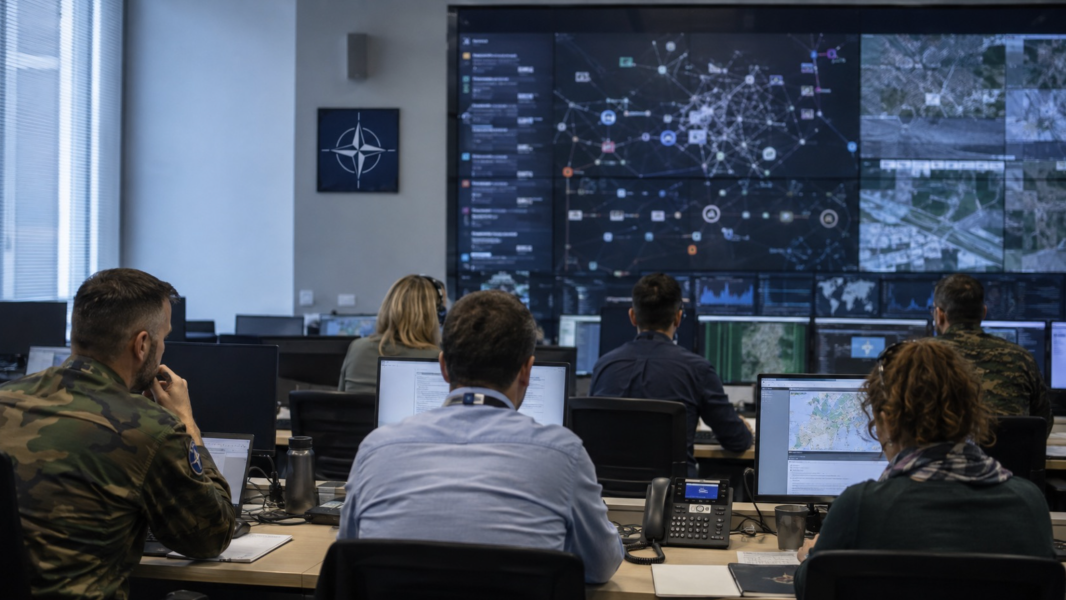
Articles published in the AFCEA Journal reflect only the views of their authors. Article originally published in French on LinkedIn on 31 August 2026. Illustration: AI-generated image.
This article was translated from French by Claude (AI). Quotations from NATO texts are given in their English wording where available, otherwise translated. In case of any discrepancy, the French version prevails.
Leave a Reply