In January 2026, US President Donald Trump publicly reiterated his wish to annex Greenland, reaffirming on the international stage the importance of this territory. Trump had, however, already expressed this ambition in 2019. The president’s renewed statement reflects an important reality: the Arctic has never ceased to be a geopolitical stake. The appeal of the world’s largest island lies in the fact that it alone concentrates the tensions running through the region: significant natural resources, a strategic geographical position and, above all, military infrastructure inherited from the Cold War that climate change is bringing back into view. The Arctic question, and that of Greenland in particular, goes beyond American ambition: the point is to understand how a 70-year-old legacy is once again becoming a factor in today’s geopolitical reconfiguration.
Militarising a frozen continent
Long regarded as an icy desert of no strategic interest, the North Pole became a major theatre of military operations from the late 1940s. The Arctic gained its geostrategic importance through the deployment of nuclear missiles, since the polar route is the shortest path between American and Soviet territory. This polar route offered a considerable strategic shortcut for intercontinental ballistic missiles.
Military infrastructure is the Cold War’s legacy in Greenland. In 1951, a bilateral agreement was signed between Denmark and the United States, within the framework of the Atlantic Alliance, authorising the construction of Thule Air Base, now called Pituffik. This base is linked to the most emblematic infrastructure of Arctic militarisation, the Distant Early Warning (DEW) Line. Built between 1954 and 1957, the DEW Line was the first and most significant surveillance and defence system: a “system of radar stations along the 69th parallel north, 300 km from the Arctic Circle”. Less well documented, Camp Century was built from 1959 onwards with a precise military objective: Project Iceworm, which aimed to deploy up to six hundred nuclear missiles aimed at the USSR through a network of tunnels dug under the Greenland ice sheet.
On the Soviet side, the militarisation of the Arctic took different forms. Severomorsk naval base was the operational heart of the Soviet Northern Fleet. At the same time, from 1955 the Soviet Union conducted around a hundred nuclear tests on the Novaya Zemlya archipelago, including the most powerful in history: the Tsar Bomba. In 1961, the Tsar Bomba exploded with a yield estimated at 4,000 times that of the bomb dropped on Hiroshima.
What these two powers had in common was that they treated the Arctic environment not as a constraint but as a tactical resource, on the assumption that ice and permafrost offered concealment and stability. That assumption has proved fragile.
Melting ice reveals the past
The fall of the USSR in 1991 led to the hasty abandonment of most of these facilities, with no real clean-up programme. On the Soviet side, economic collapse made any serious management of contaminated sites impossible. On the American side, efforts remained partial: the clean-up of the DEW Line in Canada only began in 1996, and only 21 of the 42 Canadian sites have been treated. Camp Century, closed in 1967 and left without maintenance, saw its tunnels collapse, blocking any access, evacuation or clean-up. The US authorities also considered that the waste buried under the ice sheet posed no risk of contamination.
It is precisely this assumption that climate change is now disproving. According to the IPCC’s Sixth Assessment Report published in 2021, the Arctic is warming two to four times faster than the global average – a phenomenon known as “Arctic amplification”. Permafrost, which covers around a quarter of the northern hemisphere’s land surface, has until now acted as a natural storage system for carbon, but also for the military waste buried in it. Its gradual thaw threatens to release everything, contaminating an entire region.
The case of Camp Century is the best documented. According to Lieutenant Colonel Sébastien Noël, the base still contains tens of thousands of litres of fuel, radioactive residues and millions of litres of wastewater that could eventually leak into the ocean. On the Novaya Zemlya archipelago, it is the fallout from Soviet nuclear tests that risks being mobilised and reintroduced into marine food chains, with serious health consequences for Indigenous peoples – the first to be affected by a contamination for which they bear no responsibility.
A region coveted once again
Global warming, which threatens to reactivate the dangers of the past, paradoxically opens up new strategic opportunities and has fuelled a second militarisation since the mid-2000s. In 2007, Russia symbolically planted a flag more than 4,000 metres beneath the North Pole. Since then, according to geographer Jean Radvanyi, Russia has refurbished eight former bases and built six new ones, while retaining the world monopoly on nuclear-powered icebreakers. In response, NATO has reconfigured its northern flank, with Finland joining in 2023 and Sweden in 2024, and launched the Arctic Sentry programme in February 2026. China, without owning any Arctic territory, is deploying an ambitious economic and scientific strategy there, driven by access to energy resources and new shipping routes.
Conclusion
Greenland embodies NATO’s military legacy in the Arctic: Thule Air Base, now Pituffik, and Camp Century buried under the ice, both the product of a bilateral agreement; climate change which, by melting this legacy, turns it into a threat; and a geopolitical reshuffle, between Donald Trump’s repeated statements, the return of Russian bases and China’s declared interest. Within a single territory, Greenland concentrates the Arctic’s stakes. The island will remain the place where the memory of the Cold War and tomorrow’s power rivalries concretely meet.
Leila Bekkouche
Leila Bekkouche is a master’s student in Political Studies at the École des Hautes Études en Sciences Sociales (EHESS). Her research, supervised by Sebastian Grevsmühl, focuses on the physical legacy of the Cold War in the Arctic. She is interested in the intersections of military history, climate change and the contemporary geopolitics of the Arctic.
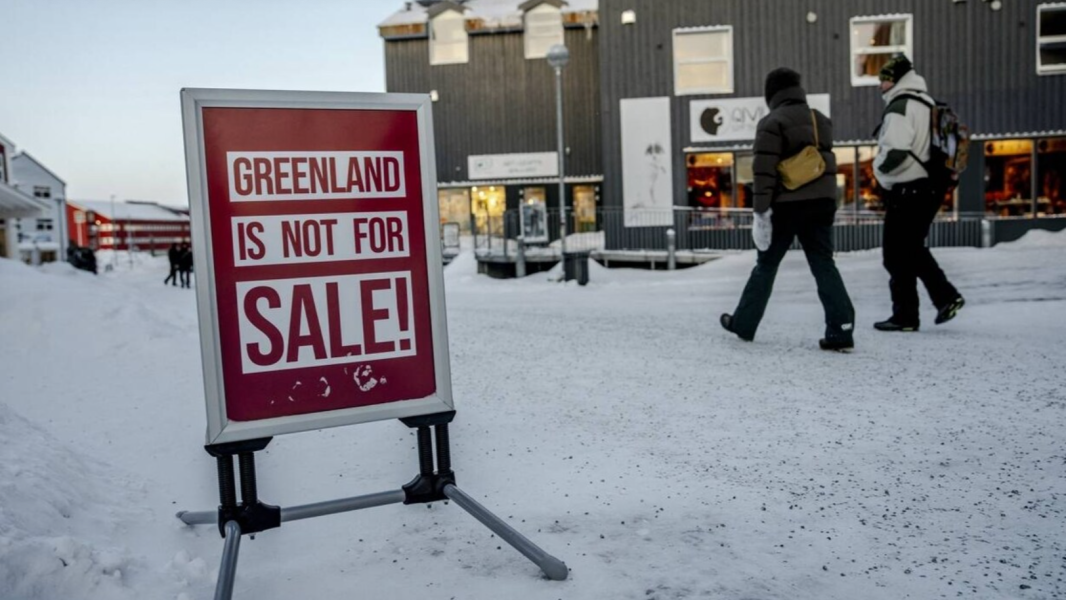
Articles published in the AFCEA Journal reflect only the views of their authors. Article originally published in French on LinkedIn on 11 August 2026. Illustration: a “Greenland is not for sale!” sign in Nuuk, 20 January 2026 – Mads Claus Rasmussen / Ouest-France.
This article was translated from French by Claude (AI). In case of any discrepancy, the French version prevails.
Leave a Reply